- Makers Challenge 2025
- Bob Emmons
Bob Emmons
Makers Challenge
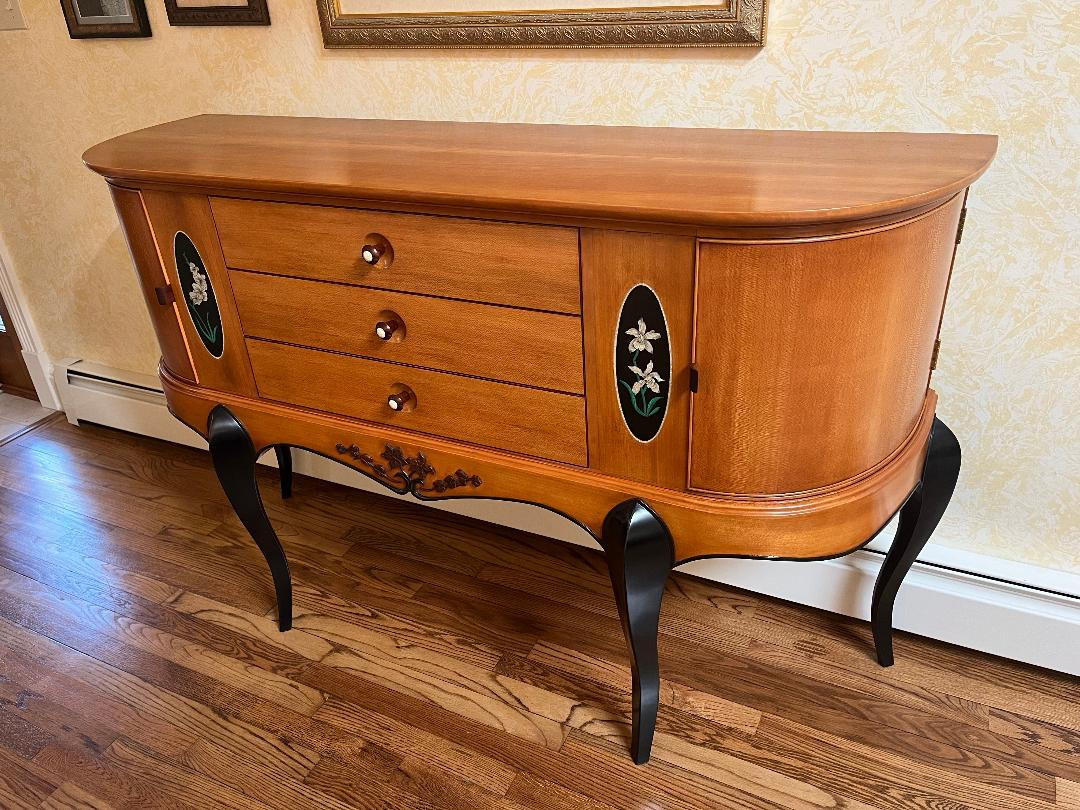
Our home needed was in need of an elegant sideboard along a long wall containing many family pictures. I wanted to design my own custom piece to fit perfectly in this space, and to compliment the other furnishings in the room. After much research; taking many pictures while visiting museums from Williamsburg to Boston, looking at samples from books and the internet, I started the process of drawing up the build.
Many period sideboards were built during the American Federal Period, but did not want to build a copy. I knew my dimensions, and also wanted to incorporate a D shaped design to eliminate a hard corner when entering the relatively small space of our family room. I also like curves in furniture, and was inspired by the rococo shaped legs and rails of many pieces. One sample that stuck out to me was a cover story of Daniel Faia’s American Entry Chest in the 2023 American Period Furniture. I also looked at contemporary samples of sideboards, appreciating the elements in their design, especially the cabinet on a stand concept. I continued to tweak my full-scale drawings until I was satisfied. What I came up with was a sideboard in two parts, a mix of traditional with rococo elements and contemporary design with an upper cabinet that sits on a stand, and easily disassembles for transport. For this build, I chose quarter sawn sycamore for my project, fascinated by the interesting fleck pattern in the wood.
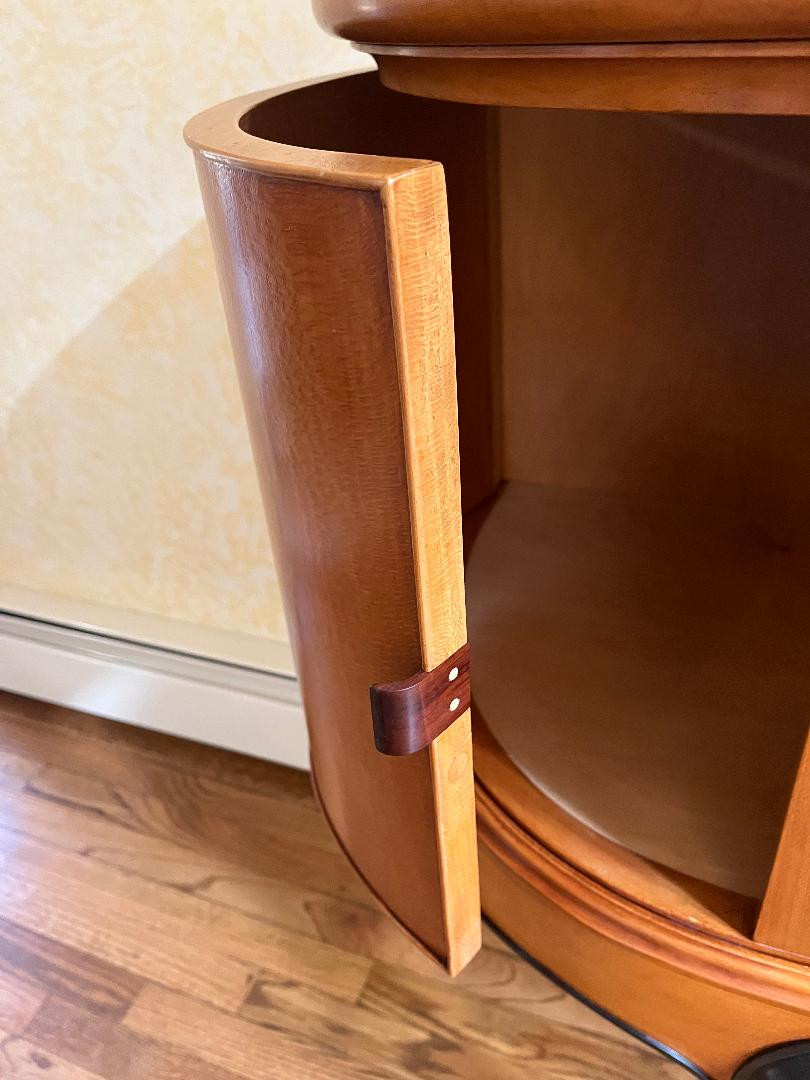
With my vision completed, I realized many new woodworking techniques were needed of me. I had never built a curved, laid up door panel using veneer and substrate in a vacuum press before, so I contacted Scott Severns at the NJ School of Woodwork and spent a day with him to gain some knowledge and items needed for this process; from veneer and substrate selection, adhesives, building molds and vacuum techniques. Scott does wonderful work and his knowledge and experience were well appreciated in addition to many articles from the Fine Woodworking and the internet. Back in my shop, I built a mold for the curved doors and obtained our clubs (Central Jersey Woodworkers Association) vacuum press, ordered the supplies and went to work practicing a couple of panels before completing the actual doors.
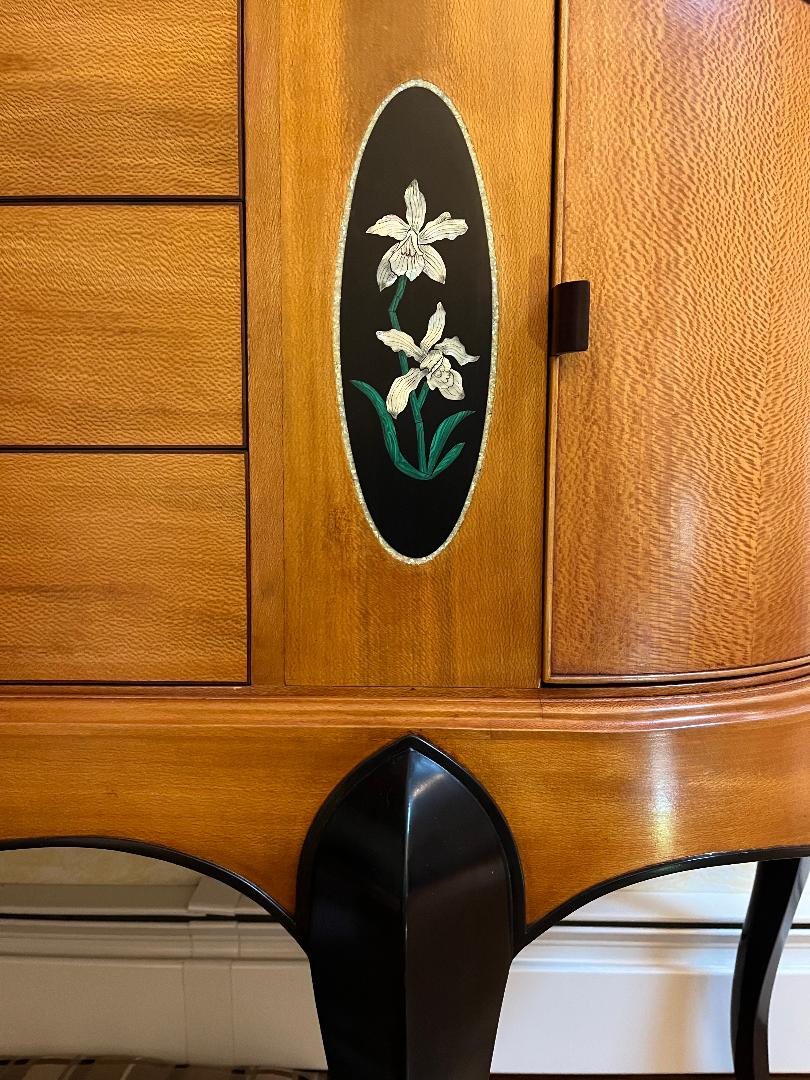
Also new to me was building a stand with a curved apron. I used brick laid construction for the curved substrate parts with shop sawn veneer covering. A decorative applied carving of orchids adorns the front. The legs are ebonized walnut with an ebony trim tracing the legs and bottom of the apron.
Like many Federal Sideboards, I wanted to showcase a decorative inlay, but with something different. In our travels, we have been exploring orchids in gardens, and chose to use an this theme for my decorative elements. I was inspired by the use of minerals and shells in luthier work, so I ordered sheets of mother of pearl and malachite, an engraving kit and spent the next month experimenting. The end result is the flowers completed in an ebony background, bordered with crushed MOP. An applied carving of orchids also graces the apron base.
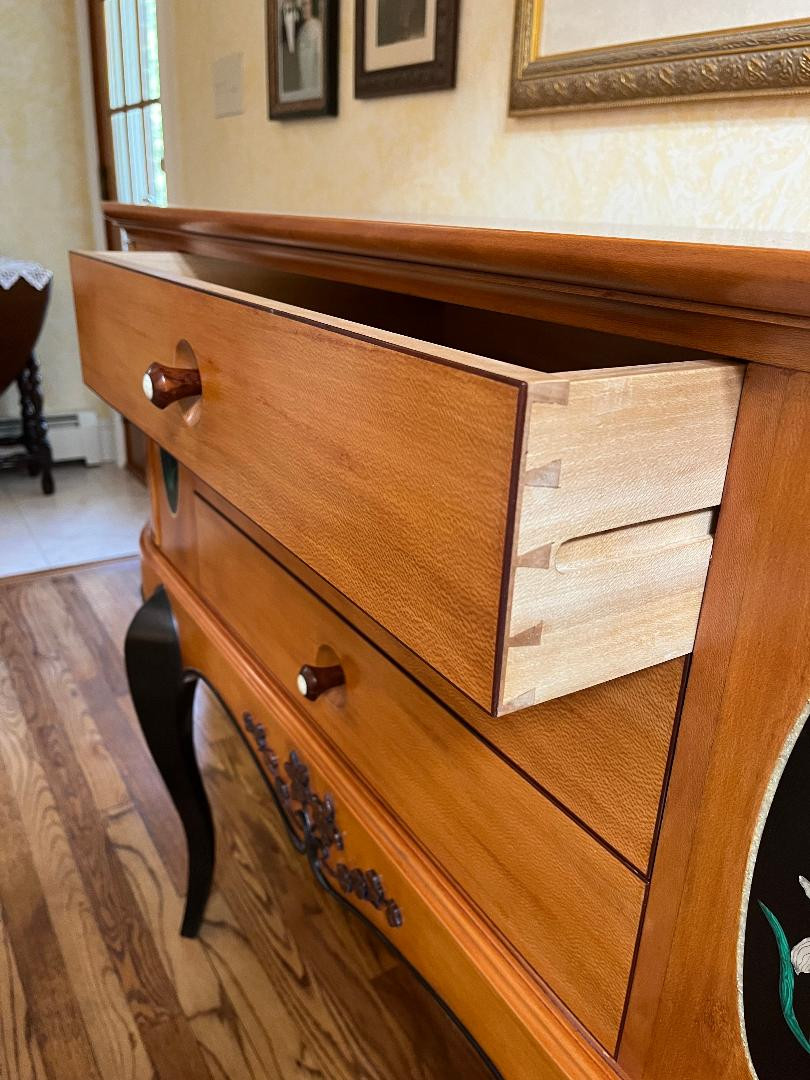
To maximize space, I decided to use a side hung drawers. Snakewood was used to edge out the drawer faces, turned knobs, and door pulls. To add extra bling on the knobs and cohesiveness to the project I added crushed MOP to the drilled-out faces.
The cabinet is finished with golden button shellac, finishers glaze, and polyurethane as topcoat.
With such limited space here, I cannot possibly list all aspects of the learning curve in this almost two-year project. I now really appreciate the amount of extra effort needed for curved work. I wanted to expand my woodworking world, and at times this became an intensive love-hate project. This piece now resides in my family room and I am so proud to say that I designed and built it!
Bob Emmons calls his entry Sideboard "Rhapsody". His design drawing is from the Federal, Rococo and Contemporary Periods. It is made of Quarter Sawn Sycamore, Walnut, Ebony, Snakewood, Mother of Pearl and Malachite. It is finished in Golden Button Shellac, Finishers Glaze and Acrylic Polyurethane It measures 60" W x 38" H x 18" D. It was made in Wrightstown, New Jersey.