
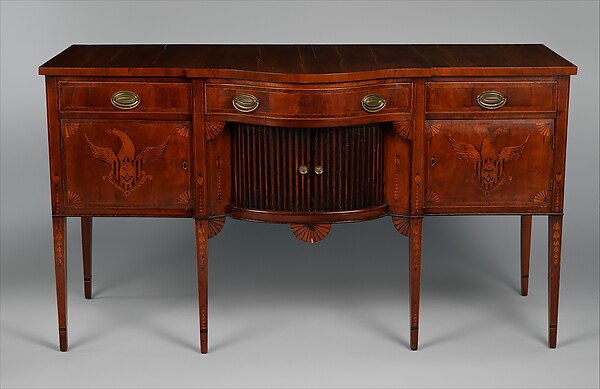
The first truly American style, rising with the new republic alongside Neoclassicism in England and the Louis XVI style in France. Where earlier furniture leaned on carving, the Federal style worked in line, proportion, and inlay — tapered legs, sharp edges, and the orderly geometry of architecture brought indoors. New forms arrive with it: the sideboard, the tambour desk, card and work tables, glass-doored bookcases, and the first swivel chair.
Design Elements
- Inlay of contrasting woods — eagles, urns, bellflowers, swags, paterae, and stringing
- Fluting and delicate finials
- Tapered legs
- Restrained carving, used to lighten a piece rather than weigh it
- Some painted highlights
- Mahogany and mahogany veneer, with satinwood, maple, and birch
Makers and regional styles
A handful of names defined the period, several through pattern books as much as benches:
- Hepplewhite — English; his posthumous Cabinet-Maker and Upholsterer’s Guide brought the shield-back chair and a hallmark lightness to American shops.
- Sheraton — English; known only through his pattern books, the most copied of the period; intricate veneer, rich upholstery, conservative carving.
- The Seymours (John and Thomas) — Boston; prized for veneering, bookmatched and contrasting, and knife-edged keel moldings set into casework.
- Duncan Phyfe — New York; reeded legs and low-relief lyres, harps, and acanthus in fine mahogany — the New York style of the era.
- Goddard and Townsend — Newport; two Quaker families whose block-and-shell case pieces and lifelike ball-and-claw feet defined the Newport school.
Adam, Lannuier, Affleck, and the Salem carver Samuel McIntire worked in the same current.