
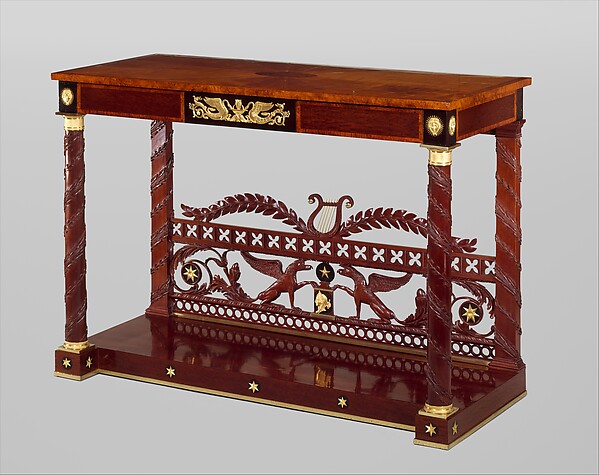
Also called the Classical style, American Empire answered the Federal period’s lightness with mass and weight — dark, architectural forms drawn from Greece, Rome, and Napoleonic France. New York led it, with Duncan Phyfe and Joseph Meeks & Sons among its best-known shops. David Alling of Newark built fine painted chairs, many with a spread eagle or turtle in the back slat, and his son Isaac carried on the trade. A late-nineteenth-century revival reworked the look in oak.
Design Elements
- Mass in place of lightness
- C- and S-curved arms and legs
- Dark woods — black-painted mahogany with ebony and maple veneers
- Gilt highlights, often stenciled
- Brass ormolu mounts and rope-carved columns
- Substantial legs ending in a carved lion’s-paw or swept foot
- Patriotic inlay — eagles, flags, acanthus, anthemion, dolphins, and rosettes
- Leather worked into casework
- Mantel clocks, sleigh beds, and sofa tables introduced