
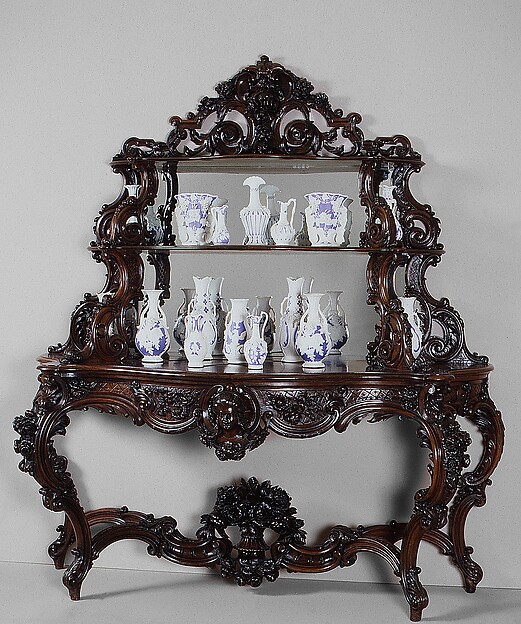
Named for Queen Victoria and centered in England, the period reached America as a succession of revivals — Gothic, Tudor, Rococo, and more — made affordable by the machine. No single maker defines it; reinterpretation and manufacture do, which is what makes a Victorian piece hard to tell from the earlier one it echoes.
Design Elements
- Formal, elaborate, often opulent
- Heavy, large pieces
- Black walnut, ash, oak, and maple, with rosewood for inlay
- Brass mounts and metal overlays
- Deeply carved ornament
- Ornate upholstery, often needlework
Styles within the period
- Gothic Revival (1840–1860) — turrets, pointed arches, and quatrefoils from the medieval; the étagère arrives; oak and walnut.
- Elizabethan / Neo-Jacobean (1850–1920) — straps and buckles, heraldry and cartouches, machined spindles, and high, narrow chair backs.
- Louis XVI (1850–1914) — straight-line carcasses under applied wreaths, urns, and flowers; straight, tapered, or fluted legs.
- Eastlake (1870–1890) — Charles Locke Eastlake’s Hints on Household Taste argued for honest, well-made furniture: rectangular forms, incised rather than applied decoration, native oak, cherry, and maple. A bridge toward the Arts and Crafts movement.