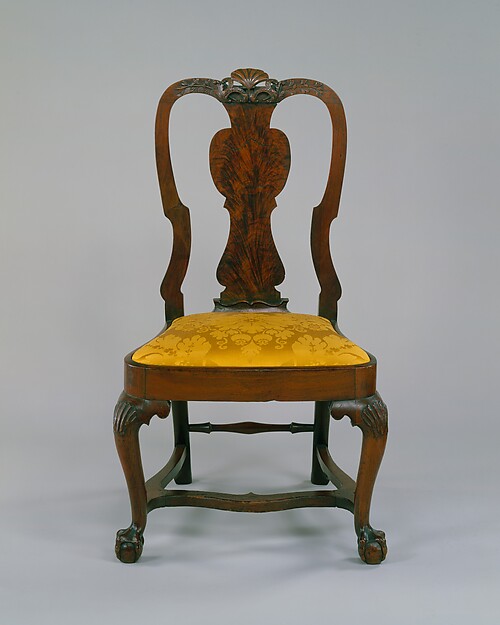
An emphasis on line and form over ornament. Often called Late Baroque; the name “Queen Anne” was applied more than a century after the style itself, which in America ran from about 1720 to 1760. It took on regional character in the cabinet shops of Boston, Newport, New York, and Philadelphia, expressed most fully in the side chair, the highboy and lowboy, and the tea table.
Design Elements
- The cabriole leg — an S-curve ending in a pad, slipper, or trifid foot
- Vase- or baluster-shaped solid splat; a yoked crest rail
- Restrained ornament, usually a single carved shell or scallop
- Compass and cushioned seats; the wing (easy) chair makes its debut
- Walnut supersedes oak as the wood of choice; maple, cherry, and poplar also common